
On March 7–8, 2026, the International Reiki Congress took place in Yverdon-les-Bains, Switzerland, marking the centenary of Mikao Usui’s passing (1926–2026). Organized by SwissReiki and Usui Reiki Verein Schweiz, the event brought together practitioners, teachers, and researchers from across different European contexts.
For the European Reiki Group (ERG), the congress represented a significant moment of presence and participation. ERG was represented by Nico Michielsen (Reiki Vereniging Cirkel), Daniela Cannillo (My Reiki), and myself. Through our participation—as speakers, attendees, and interlocutors—the work of ERG took form within the congress as a practice of dialogue across national and cultural contexts.
Over these two days, what gradually emerged was more than a scheduled event. The congress took on the quality of a shared situation, held together by listening, by a willingness to remain in dialogue, and by a sense of presence that accompanied both formal sessions and informal encounters.
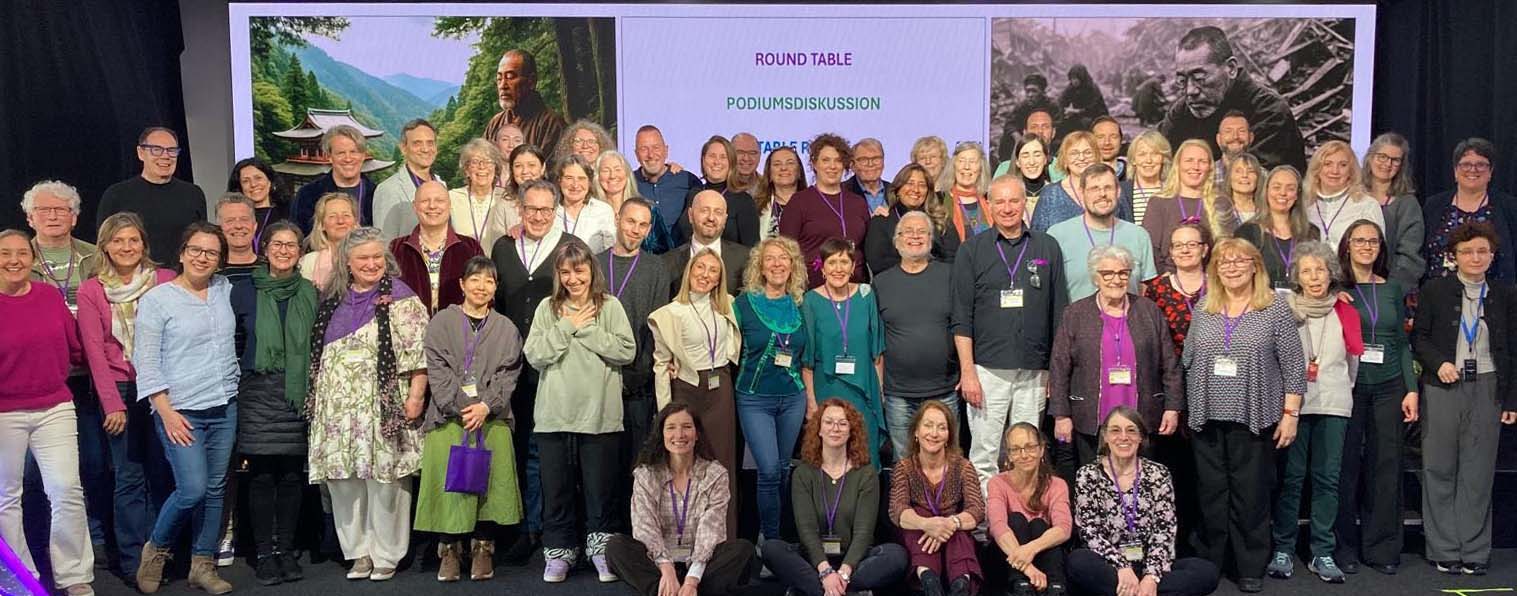
Taking part as a speaker also meant being involved in a continuous movement, where speaking and listening were not clearly separated. From within this movement, what became perceptible was less the individuality of each contribution and more the way they began to resonate with one another, forming a continuity that unfolded over time rather than following a fixed structure.
Within this context, my contribution—grounded in an anthropological approach—addressed well-being as a situated and relational process, emerging through bodies, landscapes, and shared practices. Drawing on ethnographic research on Mount Kurama, the focus was on how bodily sensations are recognized and given meaning within specific contexts.
Rather than defining Reiki in advance, the approach remained close to experience as it unfolds. Reiki appeared less as a fixed object and more as something that emerges through relations. This orientation reflects an ongoing line of work within ERG, where practice and reflection remain in relation and plurality is sustained.
Seen from this perspective, ERG’s work can be understood as an effort to hold open a space where different trajectories remain in relation without needing to be aligned. The congress also made visible a proximity with the work carried forward by SwissReiki and Usui Reiki Verein Schweiz, particularly in its attention to dialogue, professionalisation, and the place of Reiki within contemporary society.
The congress moved across different areas—history, reflection, clinical practice, lived experience—yet these did not remain isolated. A certain coherence emerged slowly, generated through proximity. Contributions that at first seemed distant began to touch similar questions, approaching them from different angles and at different rhythms.
Some talks returned to the question of origins, not as a stable reference but as something that continues to shift through interpretation. Others opened a reflective space in which themes such as ego and spirituality were addressed without being closed into definitions. At the same time, presentations rooted in clinical contexts made visible how Reiki is practiced within institutions, where its place is negotiated and redefined.
What remained noticeable was the way differences were held. They did not disappear, yet they did not become barriers. They stayed in relation, allowing listening to deepen without the need for agreement. The congress did not move toward a single discourse. It allowed different forms of knowing to remain in contact.
This quality extended into the intervals, where something less structured was taking place. Conversations continued without urgency, often without a clear beginning or end. The experience unfolded there as well, in moments where attention shifted and settled in a more open way.
On Saturday evening, the atmosphere became denser. The presentation by René Vögtli together with Frank Arjava Petter introduced a different texture, where history, memory, and personal trajectory began to intertwine more closely.
The documentary RECONCILIATION – Provoke and Evolve traces Petter’s path through some of the most sensitive passages in the recent history of Reiki, from the controversies surrounding the rediscovery of its Japanese roots to the tensions that followed between different lineages. Rather than offering a linear account, it remains close to these fractures, allowing them to stay present.
What takes shape is a process in which division is not removed, yet is gradually worked through. Reconciliation does not appear as a final point. It emerges as an ongoing effort to remain in relation across differences that continue to matter.
Through images, voice, and pacing, the film opens a space where these dynamics can be perceived without being immediately explained. Personal experience is situated within a broader historical movement, and the trajectory of one figure becomes a way of approaching a more complex field.
The following day carried this movement forward, while the commemorative ceremony for Usui Sensei, conducted by João Magalhães, gathered many of these elements into a more concentrated moment.
The ceremony unfolded without emphasis. Gestures remained simple, the pace steady. A shared field of attention took shape, held as much by silence as by what was spoken. Memory did not appear at a distance. It was felt as something passing through the situation.
As the sequence continued, a rhythm settled. The precepts, repeated together in Japanese, drew the group into a common tempo. The shift between languages did not break it. It widened it slightly, without dispersing it. The procession moved slowly, one body at a time, toward the altars and back again, each return marked by a small light now held in the hands. Transmission was not described. It remained in the gesture.
Participants did not become the same. What held was a certain quality of presence, briefly shared, without closure.
From there, the congress moved again into a more discursive space, yet something of that rhythm seemed to persist, informing the exchanges that followed without needing to be made explicit.
The final round table brought the different voices into the same space once more, without seeking closure. The question of Reiki’s contribution remained open, shaped by what had emerged rather than directed toward a conclusion.
Within this exchange, the reflections brought forward by Nico Michielsen opened an important direction. His intervention drew attention to the place of Reiki among younger generations, including children, suggesting the need to move beyond frameworks centred primarily on illness. What emerged was a shift toward well-being as a broader field, one that includes everyday experience, relational contexts, and processes of growth.
This perspective resonated with several of the themes that had circulated during the congress, while also extending them. It pointed toward possible developments in which Reiki can be approached not only in response to suffering, but also as part of a wider understanding of how well-being is lived and cultivated.
Throughout the congress, the atmosphere remained one of its most distinctive aspects. Inclusivity was not formulated as a principle. It could be felt in the way space was made for others, in the quality of attention, and in the absence of pressure to define. Dialogue extended beyond formal exchanges, becoming part of the overall texture of the event.
The organization by SwissReiki and Usui Reiki Verein Schweiz supported this process with care and precision. The structure remained clear without becoming rigid, allowing participants to orient themselves while still moving freely within the experience. The quality of the welcome and the attention to detail contributed to a sense of ease that supported engagement.
As the congress came to a close, a shared sense of emotion became perceptible. It remained quiet, present in the atmosphere and in the time people took before leaving. The experience did not end abruptly. It continued to resonate, carried forward in the connections that had formed.
Looking back, the congress can also be read as a moment of consolidation for ERG. Not as a formal statement, but as a way of being present within a wider European field. In that field, different organisations move with their own histories and orientations, at times in tension, at times in proximity.
What became perceptible in Yverdon-les-Bains was the possibility of remaining in relation within this plurality. The work carried forward by ERG, SwissReiki and Usui Reiki Verein Schweiz, while distinct, appeared at certain moments to move along adjacent lines, opening spaces where dialogue can continue to take shape.
What emerged is not a fixed image, but an ongoing process shaped by encounters, by differences held in relation, and by a shared attention that continues beyond the event itself.
Views: 178