
Reflections from within practice by Federico Scotti
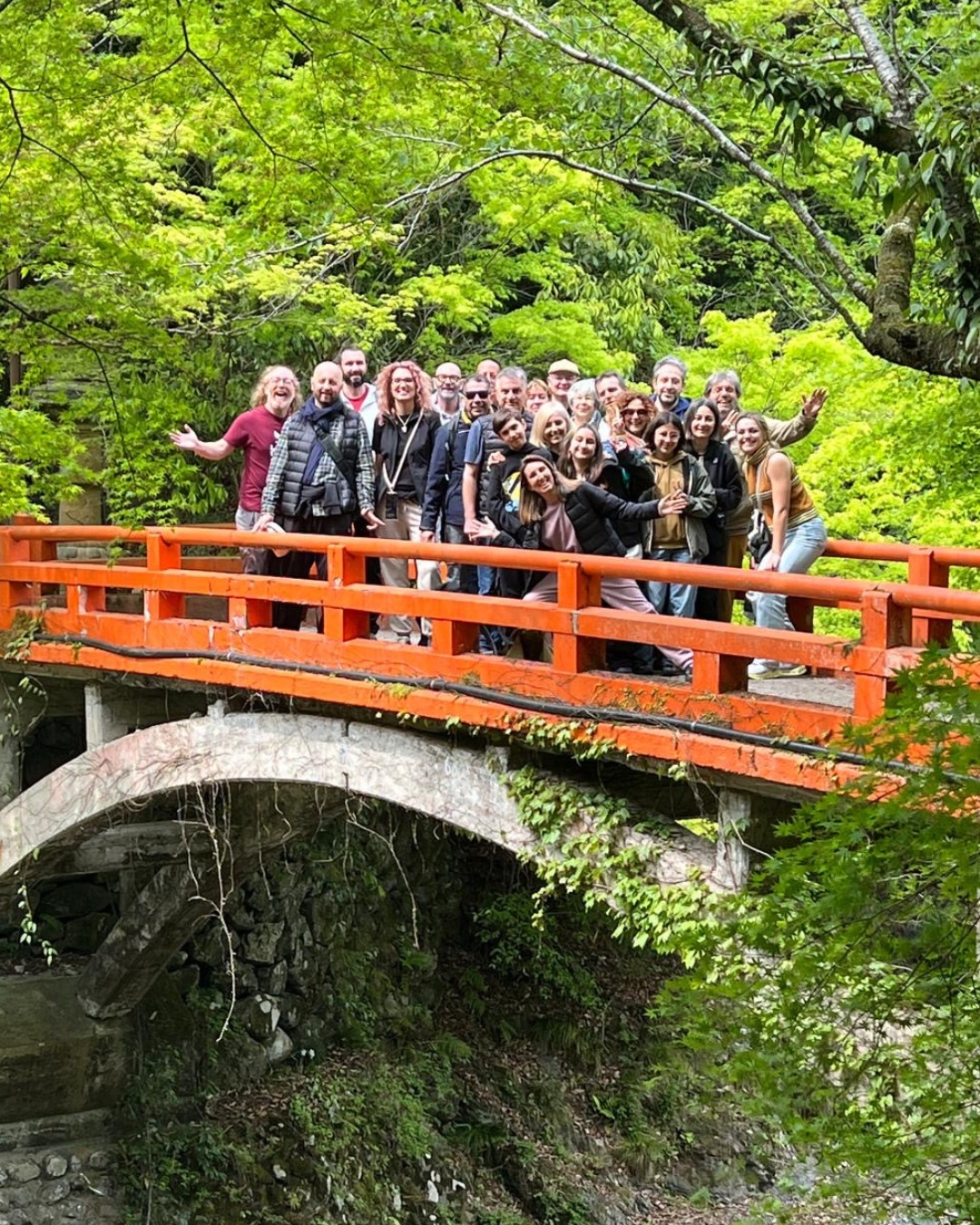
We chose this group photograph on a bridge during a Reiki study and practice journey in Japan not as a simple memory, but as a way of making visible what holds our practice together.
A bridge is a place of passage rather than destination, a space where one pauses only briefly, suspended between where one comes from and where one is going. Standing together there, we were not marking an arrival, but acknowledging a shared moment of connection.
What the image captures is not an idealized unity, but a temporary alignment of bodies, rhythms, and presences. Each person carries their own history and trajectory, yet for a moment these paths intersect. From a phenomenological perspective, this is where practice begins: not in abstraction, but in being-with, in proximity, in the subtle negotiation of distance and closeness that allows a group to take shape without erasing differences.
It is from this understanding that My Reiki has grown.
My Reiki has never been something I have done alone.
From the very beginning, it has taken shape through relationships, through encounters that unfolded over time rather than through a predefined project. It grew in practice rooms, during shared silences as much as in conversations, through the presence of people who chose to practice together, to stay, to return, and to bring their questions with them.
What gives life to My Reiki are the people who inhabit it: those who practice side by side, who share doubts and uncertainties, who carry their own histories, bodies, and sensitivities into the space of Reiki. Each person arrives with different expectations and experiences, and it is precisely this plurality that has shaped My Reiki as a living association. Rather than aiming for uniformity, I have learned to value these differences as part of the practice itself, allowing Reiki to emerge through relationship, trust, and a shared willingness to listen.
I did not begin from a fixed idea of what Reiki should be, but from practice itself—lived, embodied, and relational, often uncertain and incomplete. Practice unfolds over time, shaped by gestures, pauses, misunderstandings, and learning moments, rather than by clear definitions. What gradually emerged was a growing sense of responsibility: responsibility for how Reiki is learned, how it is practiced, and how it is spoken about, always remaining attentive to context, experience, and the people involved.
For me, Reiki has never been “only a technique.”
It is a practice shaped by history and culture, and by the concrete situations in which people encounter care and well-being, often at vulnerable or transitional moments in their lives. Meanings are not given in advance; they are negotiated within relationships, through the body, and through shared practice. In this sense, Reiki continues to take form each time it is practiced, spoken, and rethought, remaining open to questioning rather than closure.
The life of My Reiki
The life of My Reiki is made of practice circles, ongoing training, public events, and study journeys to Japan, but above all of people and of the spaces they create together. Each activity becomes a meeting place where differences are not only present, but actively lived: different backgrounds, expectations, needs, rhythms, and ways of relating to Reiki and to care. These encounters are often quiet and ordinary, yet they are where the practice takes shape.
This diversity is not something to be reduced or brought too quickly into harmony. On the contrary, it is what keeps the practice alive, allowing it to remain responsive rather than rigid. For this reason, particular importance is given to embodiment, relationality, and responsibility in care. In my experience, Reiki develops through the body—through attention, touch, and presence—through shared practice, and through dialogue that unfolds over time. It is within these relational processes, rather than in fixed definitions or abstract frameworks, that Reiki continues to find its meaning.
Integration of anthropological perspectives
A distinctive aspect of My Reiki is the integration of anthropological perspectives into its everyday activities, not as an added layer, but as a way of paying attention. This does not mean observing Reiki “from the outside,” or placing practice at a distance, but staying close to what happens in shared spaces, remaining attentive to how meanings, experiences, and narratives take shape within relationships.
Questions of legitimacy, cultural translation, and authority are therefore not treated as abstract theoretical problems to be solved, but as lived issues that practitioners encounter, feel, and negotiate over time. They emerge in conversations, in moments of uncertainty, and in the ways people situate their practice in the world. In this sense, reflection does not interrupt practice; it grows from within it, accompanying the everyday life of Reiki as it unfolds.
Over the years, this approach has grown into an ongoing anthropological research project focused primarily on Reiki practices in Italy. Grounded in ethnographic fieldwork, this research explores themes such as embodiment, therapeutic landscapes, and contemporary forms of spirituality and well-being, always in close dialogue with the people who make these practices possible.
Japan
Our relationship with Japan is another important dimension of this work, and here too relationships matter. We approach Japan as a concrete historical and cultural space, not as a symbolic origin or a source of unquestioned authority. The study and practice journeys we organize are conceived as collective, experiential, and reflective paths rather than as spiritual tourism. Participants are invited to engage bodily and critically with places, practices, and narratives, while remaining aware of distance, translation, and responsibility.
Joining ERG
Joining the European Reiki Group represents, for me and for the community of My Reiki, an important step in opening this work to dialogue at a European level. It offers a space where different practices, histories, and voices can meet, and where listening is valued as much as speaking.
Within ERG, I hope to contribute by bringing an anthropological sensitivity grounded in lived relationships: attention to how Reiki is practiced in different social contexts, how it is communicated, and how expectations around healing and well-being are shaped collectively. Rather than offering fixed answers, my intention is to open questions, support reflective practice, and nurture dialogue.
I see participation in ERG as a long-term collaboration based on exchange, inclusivity, and mutual learning. Through dialogue, shared initiatives, and practice, I hope that My Reiki can contribute to a thoughtful, open, and relational Reiki community in Europe—one in which plurality is not only acknowledged, but actively cared for.
Thank you for the welcome, and I look forward to what we will build together.
Views: 130